Message from the President and CEO 2026
The Ajinomoto Group will further evolve ASV management through a commitment to “Think Well, Do Well.”
Shigeo Nakamura
Director, Representative Executive Officer,
President & CEO
What I want to communicate
Aiming to enhance our corporate value on a sustained basis
- Keeping our formula for calculating corporate value in mind, we will take an integrated approach to strengthen cash-generation capabilities and growth potential, and reduce capital costs in order to enhance our corporate value.
- Through ongoing dialogue with stakeholders around the world, we are reaffirming the strengths of our intangible assets and taking a fresh look at our growth story. We will take concrete steps to address the challenges involved in further strengthening these intangible assets.
- By operating our seven company-wide strategies in an integrated way and sustaining a cycle of continuous improvement, we will evolve our capabilities in both planning and executing these strategies.
- By spreading the “High Speed with CHANTO” concept, we will refine the execution abilities of individual employees and organizations, and achieve our vision for 2030 ahead of schedule.
- Sustainability is what the viability of our businesses rests on and is a vital part of what allows us to stay competitive. We will strive to reduce negative impacts while creating positive ones.
- We will unite our Purpose, “AminoScience,” and intangible assets to evolve our ASV management and bring our long-term growth story to life through execution.
Introduction: Embarking on my second year
I am now in my second year as President and CEO. Over my time in this role, the one thing I have valued most is seeing the frontlines inside and outside the Ajinomoto Group and learning from the people there through dialogue. I have personally made visits to more than 50 business, sales, and manufacturing sites around the world, speaking directly and repeatedly with more than 4,500 employees—as well as customers, business partners, investors, and other stakeholders. Those conversations have been powerful reminders of the strength of our intangible assets: namely our human resources, technologies, brand, relationships of trust with customers, and company culture.
At the same time, the sharp decline in our stock price that led to a limit down, which occurred after the first-half financial results announcement in my first fiscal year as President and CEO, was a shock. It also taught me a great deal. Dialogue with the capital markets brought an important reality home to me. How people perceive our corporate value goes beyond short-term results—it also depends on the way we communicate our growth story and the credibility of our execution.
The Ajinomoto Group’s ASV management: A reflection of our founding promise
2 After more than 25 years in the Electronic Materials business, my on-site experience as President of Ajinomoto do Brasil Indústria e Comércio de Alimentos Ltda. (ABR) gave me a powerful sense of the Ajinomoto Group’s long history and the sources of its value creation. Our products were everywhere there, even in little street stalls in the Amazon. Seeing how the umami seasoning “AJI-NO-MOTO®” played a role in shaping meals throughout local communities filled me with so much respect for the pioneer spirit and commitment to social contribution that our predecessors have sustained throughout our history. The experience also gave me an opportunity to really connect with the idea that underpins everything the Ajinomoto Group does: continuing to deliver value to people’s lives. With “AminoScience” at the core of our efforts, we now conduct businesses in the fields of Food Products and Bio & Fine Chemicals, as well as in their Convergence Areas, across the globe. I take pride in the fact that our proprietary technologies have diversified into a wealth of products that provide value in so many forms in so many countries.
For many years, the Ajinomoto Group has practiced ASV (Ajinomoto Group Creating Shared Value) management—a commitment to co-creating social and economic value through business. Striving to bring our Purpose of “contributing to the well-being of all human beings, our society and our planet with ‘AminoScience’” to fruition, we have upheld the values of “create new value,” “pioneer spirit,” “social contribution,” and “value people.” These tenets have been passed down from generation to generation as the Ajinomoto Group Way, or AGW. “AminoScience” is the scientific approach that sets the Ajinomoto Group apart, the product of more than a century of amino acid research and practical use. As an executive with a technical background, I do not see “AminoScience” simply as a collection of technologies. For me, it represents a source of growth and competitive advantage. The Deliciousness Technology we have developed in the area of food, our scientific knowledge geared toward health and medicine, and our advanced technologies seen in Electronic Materials and Bio-Pharma Services may appear to belong to different businesses. At their roots, however, vital intangible assets link them together.
To keep increasing our corporate value from both the short- and long-term perspective, we need to continuously demonstrate our ability to create value in a sustainable way and the assets we have—tangible and intangible alike—to support that ability. While taking serious, honest looks at short-term concerns and issues and making necessary adjustments quickly, I will strive to further evolve our ASV management and refine our ability to grow and generate earnings over the long term.
Concepts shaping our growth strategy
The Ajinomoto Group’s growth strategy is clear: Build on steady growth in the Food Products business, achieve dramatic growth in the Bio & Fine Chemicals business, and create new value also in the Convergence Areas where they meet. Starting from existing businesses, we will pursue continuous growth by boosting productivity through operational excellence, digital transformation (DX), and AI and by advancing initiatives that further enhance our stable revenue base. While boldly taking on the challenge of new products and markets, in new areas and Convergence Areas, we will aim for inorganic growth by combining the Ajinomoto Group’s technology and organization assets in areas such as medicine and food, materials and services, and the digital and real with customer assets to create unprecedented value. Our visions for both kinds of growth do not stand in opposition, however. We will quickly apply the intangible assets and scale we have developed in our existing businesses to new areas, generating value that we will then bring back into the Group. This cycle is the Ajinomoto Group’s unique growth model.
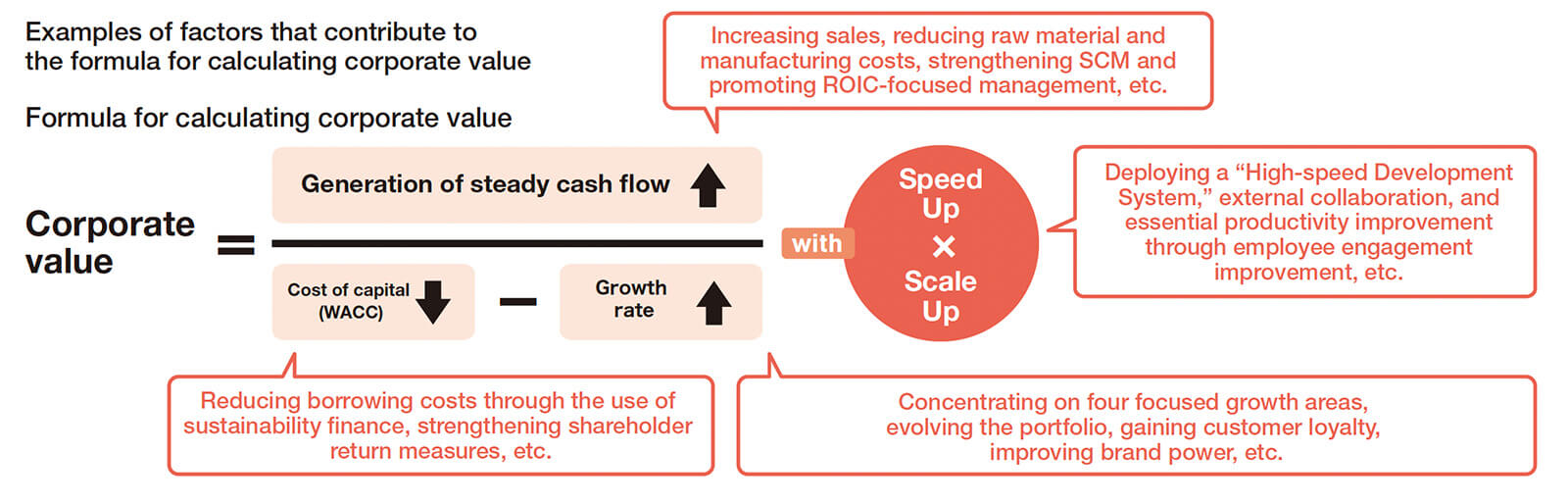
The formula for calculating our corporate value is as follows. To generate steady cash flow for the Group, we will refine both our growth and profitability through organic growth, improved EBITDA margins, promotion of ROIC management, streamlining of various costs for elements like raw materials and manufacturing, inventory management, and strengthening of supply chain management. To generate funds for growth, we will identify not only unnecessary costs, such as costs that do not contribute to achieving our strategies, excessive operating costs, and costs in noncompetitive fields, but also costs that we assume to be necessary but can actually reduce. Through this process, we will make our businesses and organizations leaner and stronger. Ultimately, we will then take these cost reductions and translate them into spending for growth.
To reduce capital costs, we will utilize sustainable finance through promotion of sustainability, strengthen risk management, reduce borrowing costs, and utilize appropriate financial leverage. Raising the growth rate, meanwhile, will entail enhancing our capabilities in both planning and execution for short-, medium-, and long-term business strategies and taking Speed Up × Scale Up to an even higher level. With this formula for calculating our corporate value always in mind, we will combine the ingenuity, efforts, and challenges of our organizations to enhance corporate value.
We will take bold steps forward in investments for growth. However, we will not ease up on the cash-generation capabilities and investment discipline that make those investments possible. Cash is not an end in itself. It is a means for continuing to create value. That is why we need to keep asking ourselves the following question whenever we take action on fronts ranging from capital investments and M&A to shareholder returns and financial soundness: Will this really lead to long-term value? This approach is something we will share company-wide and connect to the next stage of growth.
The current status of the Ajinomoto Group
We have made progress on our ASV Management 2030 Roadmap in both quantitative and qualitative terms. In fiscal 2025, ROE reached 17.7%, and the EBITDA margin was at 17.1%, showing steady performance. For ROIC, as a manufacturing company, investment in both tangible and intangible fixed assets is essential to sustainable growth. We therefore plan to maintain a sound level that balances growth investment and capital efficiency. On the social value side, we have seen steady progress in indicators associated with efforts such as reducing environmental impacts, extending healthy life expectancy, and securing employee engagement. These are not just numerical targets either; little by little, these efforts are starting to generate real results in value creation that ties into actual business.
In our core businesses, the Sauce & Seasonings and Quick Nourishment businesses achieved solid growth, while the Frozen Foods and Solution & Ingredients (S&I) businesses continued to recover. The Bio & Fine Chemicals area continued to see high growth, particularly in the Electronic Materials business and Bio-Pharma Services, and we are steadily enhancing our business foundation for propelling future growth. The important point is to keep looking at these results as milestones on the path to the next stage of growth. The areas where we need to evolve to keep growing into the future have come into clearer view. There are many: our global human resources strategy, the way we share and roll out technologies and knowledge that shape our competitive edge, our approaches to refining brands by region and business, further improvements in productivity and organizational capabilities, steps to enhance the efficiency of management resources, and the speed of our decision-making, to name several. These, I recognize, are management issues that we cannot afford to put off. Our medium- to long-term business strategy is to root ourselves in our Purpose and, looking ahead to 2030, pursue what we want to be as a company in the areas of Healthcare, Food & Wellness, ICT, and Green, which we have set as four focused growth areas where we can utilize the Ajinomoto Group’s strengths. In Healthcare, we have established a Center of Excellence in Boston (United States) to serve as a hub for cross-organizational initiatives. We will accelerate business development by providing bio-pharma services in integrated packages with ancillary materials (culture media and other auxiliary materials used in the manufacturing processes for cell and gene therapy products). In Food & Wellness, we will leverage the Ajinomoto Nutrient Profiling System (ANPS) for health solutions that we can provide as a platform for combining medicine and food, bringing together digital services and physical products. For ICT, we will aim to create even more new functional materials—including materials for Photonic-Electronic Co-packages—by evolving Ajinomoto Build-up Film™ (ABF™) for advanced semiconductor packages and devices. In Green, our vision goes beyond just improving productivity—we also want to convert the creation of environmental value, such as GHG reductions, into financial value. One way of doing that will be combining biostimulants and soil improvement solutions, an approach that will help us build sustainable agrifood systems. Our initiatives also include a new project to cultivate an environment that strengthens people and organizations in an integrated way, enabling us to create, support, and develop new businesses.
As we continue to evolve our business portfolio, meanwhile, we need both the courage to see things through to the end and the ability to know what to change. Some businesses have potential to create significant value when we take the time to develop their offerings, as seen in ABF™ in the Electronic Materials business and AjiPro®-L, an amino acid lysine formulation for cattle. At the same time, though, strategic resource reallocation is also essential. Understanding that changes in customers, competitors, and the environment are inevitable, it is critical that we continuously review and adjust our businesses and enhance the way we allocate resources based on balancing growth potential, profitability, and risk. Turning business synergies into effective results is another key focus. To do that, we need to link them with concrete business strategies, organizational operations, and evaluation systems.
Management policies in the new framework
In my first year, I focused squarely on the management policy for fiscal 2025: “Think Well, Do Well” from Our Philosophy and Purpose. In other words, the year was about conceptualizing and executing matters with a healthy sense of urgency and cultivating people and organizations that embody our Purpose. Immediately after becoming CEO, I drew up a 60-day plan. All of our officers then held intensive discussions on topics such as medium- to long-term business strategies, enhancement of our corporate brand, governance, and the use of data and AI. Throughout the talks, I kept focusing on one core question: How can we implement the High-speed Development System and enhance our capabilities in both planning and execution? I also made it a point to follow through on the discussions. We needed to translate them into concrete terms: who would execute what and by when.
To put ourselves in an even better position to execute the 2030 Roadmap effectively, we organized the initiatives into seven company-wide strategies. The seven strategies are not just a set of measures to undertake. With the Medium- to Long-Term Growth Strategy, Portfolio Strategy, and Financial and Capital Strategy forming the core framework, Organizational Execution Capabilities, Sustainability Strategy, Stakeholder Engagement, and Strengthening of Corporate Governance and Compliance—a foundation underpinning everything else—complete the picture. The key is to make these strategies work together as one. Only then can concepts make their way through execution and deliver results in the form of corporate value. We will position AI and data use as a management operation system to help us think better and faster, a foundation for advancing our company-wide strategies. AI and data have gone past simply being tools for limited enhancements. They are essential components for management—and part of the workforce. In external environment analysis, competitive landscape analysis, development, resource allocation, and every other area where we need to make decisions, AI and data will be the tools our people use as they ask critical questions and decide what to do. To support that shift, we will improve our data infrastructure, develop our knowledge AI, and work to make AI a valuable tool company-wide.
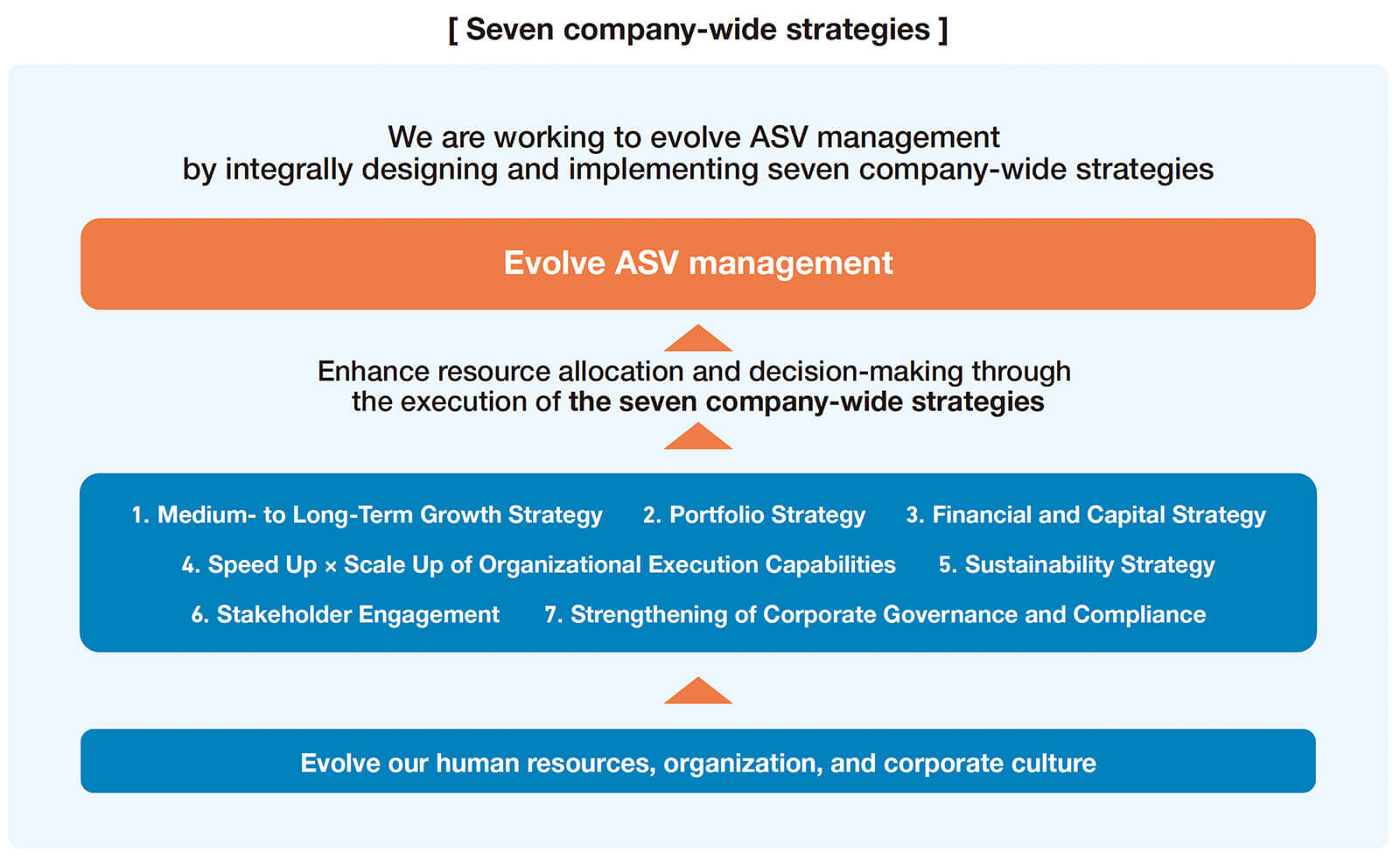
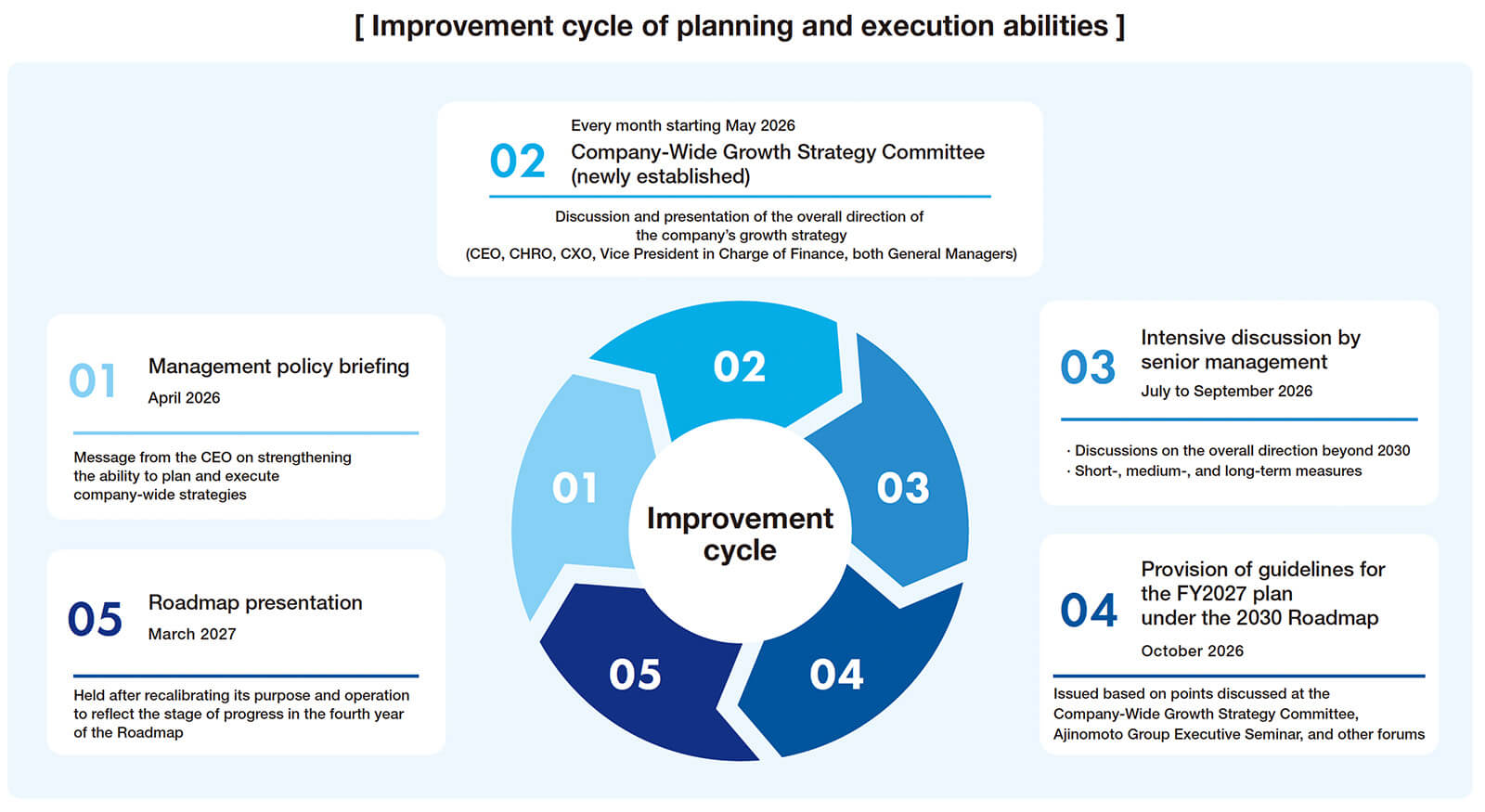
To drive the seven company-wide strategies forward in an integrated, cohesive way, we are creating a new forum for strategic discussions in fiscal 2026—the Company-Wide Growth Strategy Committee—which will chart out the general direction for the company’s growth strategy. Based on the company-wide strategies, we will hold intensive discussions with all Executive Officers and Directors through the Ajinomoto Group Executive Seminar and other forums. The dialogues will cover overarching paths forward over the medium to long term, including post-2030, along with short-, medium-, and long-term measures. Participants will draw on those discussions to determine guidelines for the following fiscal year’s targets, and we will receive regular reports on progress and initiatives for future growth. By sustaining this cycle of continuous improvement, we will steadily evolve our capabilities in both planning and executing our company-wide strategies.
One issue shaping these company-wide strategies is that the functions of our headquarters still lean too heavily toward Japan. The Ajinomoto Group needs a framework that shares its common philosophy, resources, R&D, and other strengths worldwide, sets global directions for matters like strategies and resource allocation, aligns organizations, and then allows each business and region to expand autonomously. The goal for us, then, is to build an autonomous, decentralized, and connected global management structure. We envision a structure that enables us to grow together as one Group, sharing our strategy and overall direction while respecting the autonomy of businesses and regions around the world. As part of that effort, we made adjustments to our executive structure this April. To speed up decision-making, we did away with the Corporate Division. We also established the position of Chief Human Resources Officer, or CHRO, to link our company-wide strategies and human resources strategy more closely. The CHRO will take responsibility for human resources—some of our most important intangible assets—and oversee organizational strategy. At the same time, we have appointed talent with diverse backgrounds and expertise to executive officer roles to bring more varied perspectives to the management team and enhance our decision-making capabilities. Each Executive Officer will bring decisive expertise and responsibility from Group and global perspectives, show consideration for one another, keep the best interests of the entire company in mind, and pursue both Speed Up and Scale Up, and co-create the future.
Enhancing our capabilities in both planning and execution: The key to our next growth steps
The management slogan I have set is “Think Well, Do Well.” That is more than just a statement. It captures what we need to do: envision what comes next, shape that vision into company-wide strategies, translate those strategies into the strategies of individual businesses and functions, and enable people on the frontlines to take ownership of and execute the resulting strategies, learning and honing their strengths as they press on. The question for us is how powerfully and quickly we can make that cycle work as a company.
Based on my own experience, the High-speed Development System plays a crucial role in putting that conceptual approach into practice. It involves anticipating customer needs and occasionally even risks, preparing multiple solutions, and making continued improvements while receiving feedback. Electronic Materials is just one area where the High-speed Development System makes a difference; it can apply to every area of the Ajinomoto Group, including the Food Products business and corporate functions.
That said, speed is not the only goal in my eyes. We also need the values that the Japanese word “CHANTO,” or “properly,” expresses. We need to communicate properly, understand data and assumptions properly, engage with stakeholders properly, and execute matters sincerely and properly. Speed and trust working together—that is what gives execution abilities the power to “Scale Up.”
Refining intangible assets and scaling up execution
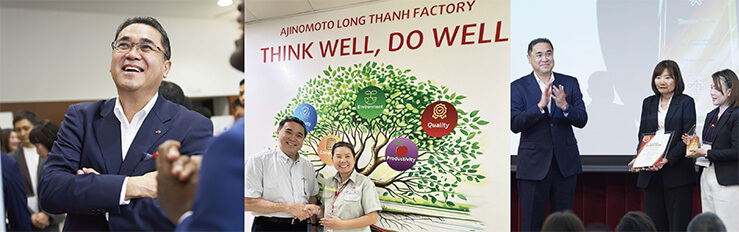
Since becoming CEO, I have held repeated dialogues with a total of more than 4,500 employees around the world. After sharing a bit about me as a person, I carefully explained matters such as the ideas behind my management slogan and how the High-speed Development System came into being. When I spoke with people overseas, I also touched on how recognizing and respecting cultural differences allows diversity to fuel creativity. I made it clear that an innovative company culture depends not only on the psychological safety that we have valued since the previous CEO’s tenure but also on a stance of intellectual integrity—being open about one’s own opinions and knowledge while being sincere in how one receives and connects with the ideas of others. The meetings included time for open questions and comments as well—and for anything that would take us past the allotted time, I asked employees to email me directly. One employee sent me a message, saying, “I came away believing that you understand how much we want to devote ourselves to our work with passion and a sense of purpose. I look forward to more opportunities for dialogue, and I will keep working to spread that sense of determination with colleagues who feel the same way.” As I read that email, I got a powerful sense of what these dialogues could do—and I also realized this kind of engagement is where our ASV management cycle begins. When I visited local sites, I saw my management slogan, “Think Well, Do Well,” on display. It was so moving to see that people had taken my message to heart. I want us to be a company where every employee’s voice reaches the CEO—and receives a response.
The source of growth lies in intangible assets. As we work to strengthen our four intangible assets—human assets, technology assets, customer assets, and organization assets—one by one, we also need to link them together and scale them up as execution abilities.
Having reaffirmed through my dialogues that human resources are the Ajinomoto Group’s greatest intangible assets, we will give our people what they need to take on a range of challenges in the AGW spirit. I believe that the diligent, day-to-day commitment to pursuing continuous growth, refusing to put off until tomorrow what we can do today, and moving in a better direction than yesterday—even just slightly—is a challenge in itself. To help each employee see the High-speed Development System as a way to fast-track improvements and take on challenges, we are moving forward with a variety of initiatives. Examples include a compensation system that recognizes bold endeavors, expanded support for autonomous career development that enables both individual employees and the company to grow together, and the globalization of systems that align with our strategies.
In new businesses, we have organized several of our existing systems into a new initiative under the name INNOSEED by AJINOMOTO Group. This initiative, which combines knowledge and resources from inside and outside the company, creates an end-to-end path to allow technology-driven ideas to move quickly toward commercialization as well. We will also foster a culture where employees and organizations can fully utilize their innate capabilities and take on challenges and grow proactively. We will also promote true diversity management. That means appointing the right human resources to the right positions and creating an environment where talent of different genders, nationalities, experiences, and areas of expertise can exchange views openly and naturally—all with psychological safety and intellectual integrity at the foundation. Working as one, we will continue to strive toward our vision of becoming “the No. 1 organization for high employee engagement.”
Sustainability and the creation of social value
As we make our way toward 2030, we are targeting a 50% reduction in environmental impacts and committing to extending the healthy life expectancy of one billion people. We will not only reduce negative impacts but also strive to create positive impacts too.
Last September, I took part in a private-sector meeting of the United Nations Global Compact to discuss global climate action. In November, I also attended COP30, the 30th Conference of the Parties to the United Nations Framework Convention on Climate Change, in Belém, Brazil. The global average temperature rose more than 1.5°C above preindustrial levels in 2024, exceeding the 1.5°C threshold that the Paris Agreement aims to keep the world below. Agrifood systems account for 22% of global GHG emissions, making them the second-largest source after the energy industry. At the same time, though, population growth continues to increase the need for food As we make our way toward 2030, we are targeting a 50% reduction in environmental impacts and committing to extending the healthy life expectancy of one billion people. We will not only reduce negative impacts but also strive to create positive impacts too.
Last September, I took part in a private-sector meeting of the United Nations Global Compact to discuss global climate action. In November, I also attended COP30, the 30th Conference of the Parties to the United Nations Framework Convention on Climate Change, in Belém, Brazil. The global average temperature rose more than 1.5°C above preindustrial levels in 2024, exceeding the 1.5°C threshold that the Paris Agreement aims to keep the world below. Agrifood systems account for 22% of global GHG emissions, making them the second-largest source after the energy industry. At the same time, though, population growth continues to increase the need for food our solutions, such as AjiPro®-L and biostimulants, as examples of our initiatives in the Green area to create environmental value and economic value at the same time. Through continued communication at international forums such as COP, we will accelerate value creation on a global scale.
Our sustainability initiatives are about more than meeting social demand. They are what the viability of our businesses rests on—and a vital part of what allows us to stay competitive. By incorporating our efforts to reduce environmental impacts, promote resource circulation, improve well-being, and tackle other social issues into our business activities, we can translate them into long-term enhancement of our corporate value. That, to me, is an important form of ASV.
To our stakeholders
Our stakeholders expect the Ajinomoto Group to maintain a stable foundation and demonstrate long-term execution abilities. To make sure that the company lives up to those expectations, I will face the issues in front of us head-on and bring our long-term growth story to life through execution.
At our management policy briefing for the Group in fiscal 2026, my message to everyone was a series of questions. To survive and evolve while anticipating and adapting to medium- to long-term changes in customers, competitors, and the environment, what exactly do we need to do now? Three, five, and 10 years from now, what areas will we sell products and services in? What will those products and services be? How will we build competitive advantages, and what should we start doing now to generate longterm profits? What do you see in the future, and how are you going to act from today onward? Guiding us forward at the Ajinomoto Group are our founding Purpose, the strength of “AminoScience,” and our human resources—the greatest intangible assets we have. By bringing these strengths together in the “Think Well, Do Well!” spirit and continuously refining the execution abilities each and every employee brings to the table, we are set on achieving the 2030 Roadmap ahead of schedule. Put together the execution abilities of every employee and you get the company’s power to create value. Put together the growth of each individual person and you get the company’s development. Everything adds up to bigger results.
With an accurate grasp of changes in the business environment, we will continue to optimize our business portfolio, strengthen our management foundation—including intangible assets—and evolve our organizational operations. These efforts will drive us forward, helping us enhance our corporate value in a stable, sustainable way as a company that contributes to the well-being of people, society, and the planet. I look forward to bringing that goal to fruition with all of you.