
Why the Ajinomoto Group is Deeply Committed to Quality – And How the Everyday Actions of Employees Around the World Bring Our Quality Assurance to Life

Reading Time: 6minutes
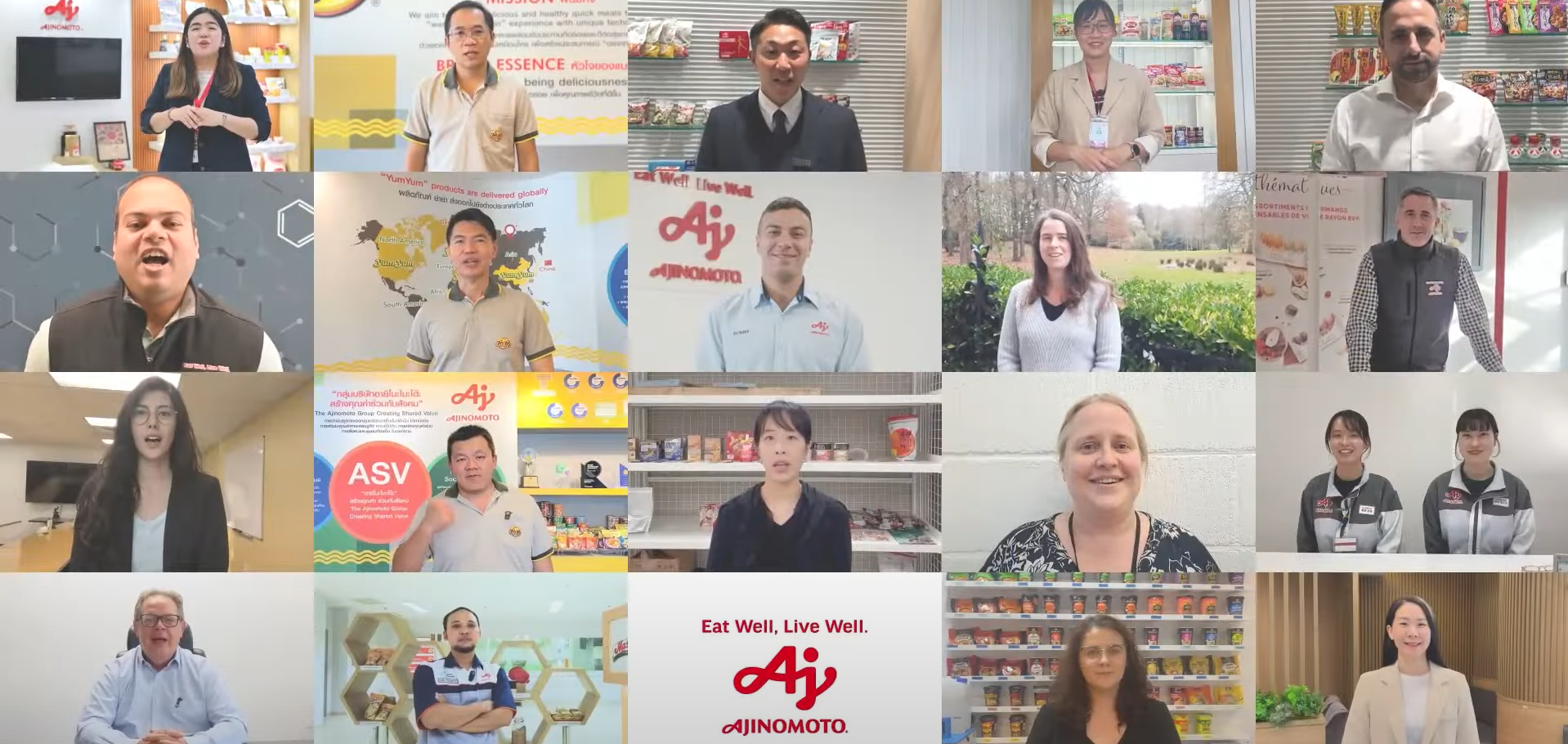
The Ajinomoto Group’s business extends beyond food to a wide range of fields, including healthcare, ICT, and environmental-related areas. These businesses are conducted across 31 countries and regions worldwide, where employees with diverse backgrounds engage in business that is rooted in the culture of each local community.
Within the Ajinomoto Group, which operates such a broad range of businesses and handles a diverse portfolio of products, particular attention is paid to “quality.”
Approximately 35,000 employees of the Ajinomoto Group worldwide are committed to quality and safety. They are their highest priorities.
This is because they understand that transparency regarding quality and safety is the most important factor in building trust between a company and its customers.
Quality assurance requires strict rules and standards. But it can only be achieved through the daily efforts of each and every employee. Below, we explore why that is—and introduce the work of Ajinomoto professionals around the world who make it possible.
What Does Quality Assurance Mean to Us?
Let us take a moment to revisit the meaning of the term “quality assurance.”
Many people think of quality assurance as “simply checking whether finished products have defects.” However, this represents only a small portion of quality assurance activities.
In its true sense, quality assurance (QA) refers to the activities that ensure products and services meet specified quality standards and provide reliability to customers.
In other words, quality assurance is a company-wide effort that requires managing quality at every stage, including design and manufacturing, implementing initiatives to prevent problems from occurring in the first place, establishing systems to prevent defects before they arise, and building and properly operating systems for continuous quality improvement.
Why is the Ajinomoto Group Deeply Committed to Quality?
Quality assurance is not limited to manufacturing. Across a wide range of industries and sectors such as service industries, IT, healthcare, and education, it is increasingly recognized as an essential element for organizational success.
Typically, a company’s quality management department plays a central role in acquiring quality assurance certifications and facilitating quality control and quality assurance activities in accordance with established rules and standards.
What is a Quality Assurance Certification System?
Many people are familiar with the terms ISO and JIS. These are common sets of rules to show that quality meets certain established standards.
What is ISO?
ISO is the abbreviation referring to the International Organization for Standardization. ISO standards were established with the aim of facilitating smooth international trade. By adopting ISO standards, companies can provide products and services with consistent quality, which helps build strong trust in business relationships.
Among these standards, ISO 9001 is the most widely adopted international standard for quality management systems, used by more than one million organizations in over 170 countries worldwide.
What is JIS?
JIS (Japanese Industrial Standards) is Japan’s national standards system established under the Industrial Standardization Act. These standards were designed to unify the quality and safety of products and services in Japan.
Standards are organized across a wide range of fields, such as kitchen equipment, screw sizes, incandescent light bulbs, and automotive parts, providing a foundation that allows people to use Japanese products with confidence.
What is the Ajinomoto Group’s Quality Assurance System, “ASQUA”?
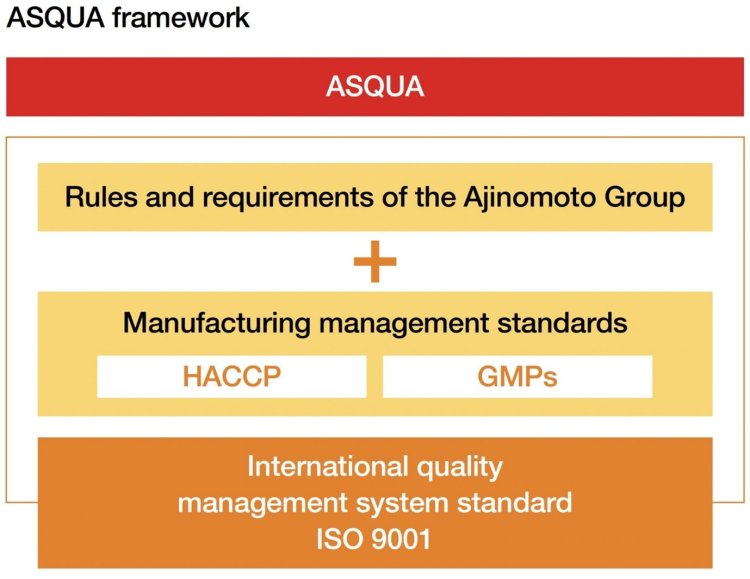
“ASQUA” is the Ajinomoto Group’s proprietary quality assurance system, established in 1997. The name stands for “Ajinomoto System of Quality Assurance.”
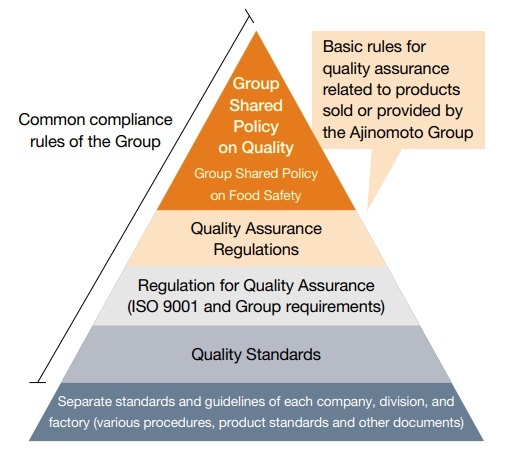
ASQUA represents common rules across the Ajinomoto Group. Each organization and affiliate establishes its own operational rules in compliance with these group-wide standards.
These Ajinomoto Group common rules consist of the “Group Shared Policy on Quality,” the “Group Shared Policy on Food Safety,” the “Quality Assurance Regulations,” the “Regulation for Quality Assurance,” and various quality standards. These are harmonized with international standards such as ISO 9001 and GFSI (Global Food Safety Initiative)-recognized certification schemes.
Based on these common rules, approximately 100 Ajinomoto Group companies worldwide thoroughly implement quality assurance activities under ASQUA, from product development to customer support, thereby ensuring high-quality products.
What Quality Assurance Means to the Ajinomoto Group
At the Ajinomoto Group, each and every employee is committed to quality assurance.
Our end-to-end approach to quality assurance applies to every stage, from raw material procurement and design to manufacturing, shipment, sales, and even after-sales service following customer purchase. This represents a strategic initiative to enhance organizational competitiveness and achieve sustainable growth.
Furthermore, the Ajinomoto Group’s commitment to quality goes beyond improving the quality of products and services and is deeply rooted as part of its corporate culture.
The Ajinomoto Group believes that when all employees act with quality in mind in their daily work, it enhances the reliability and sustainability of the company as a whole.
What is the Ajinomoto Group Policy (AGP)?
In the Ajinomoto Group, our purpose is to contribute to the well-being of all human beings, our society and our planet with “AminoScience.” That’s why we pursue ASV initiatives. ASV stands for Ajinomoto Group Creating Shared Value and refers to our unique approach to resolving social issues through our business and improving economic value by creating shared value with society and local communities. Pursuing ASV is only possible if each of us in the Group works hard to earn the trust of society.
Accordingly, we have established the principles that illustrate the beliefs and behaviors which the companies in the Group and each of us who work there should uphold, naming them the Ajinomoto Group Policies (AGP). The AGP sets forth fundamental and universal ways of thinking related to business activities.
Detailed information on the AGP is available on the Ajinomoto Group website.
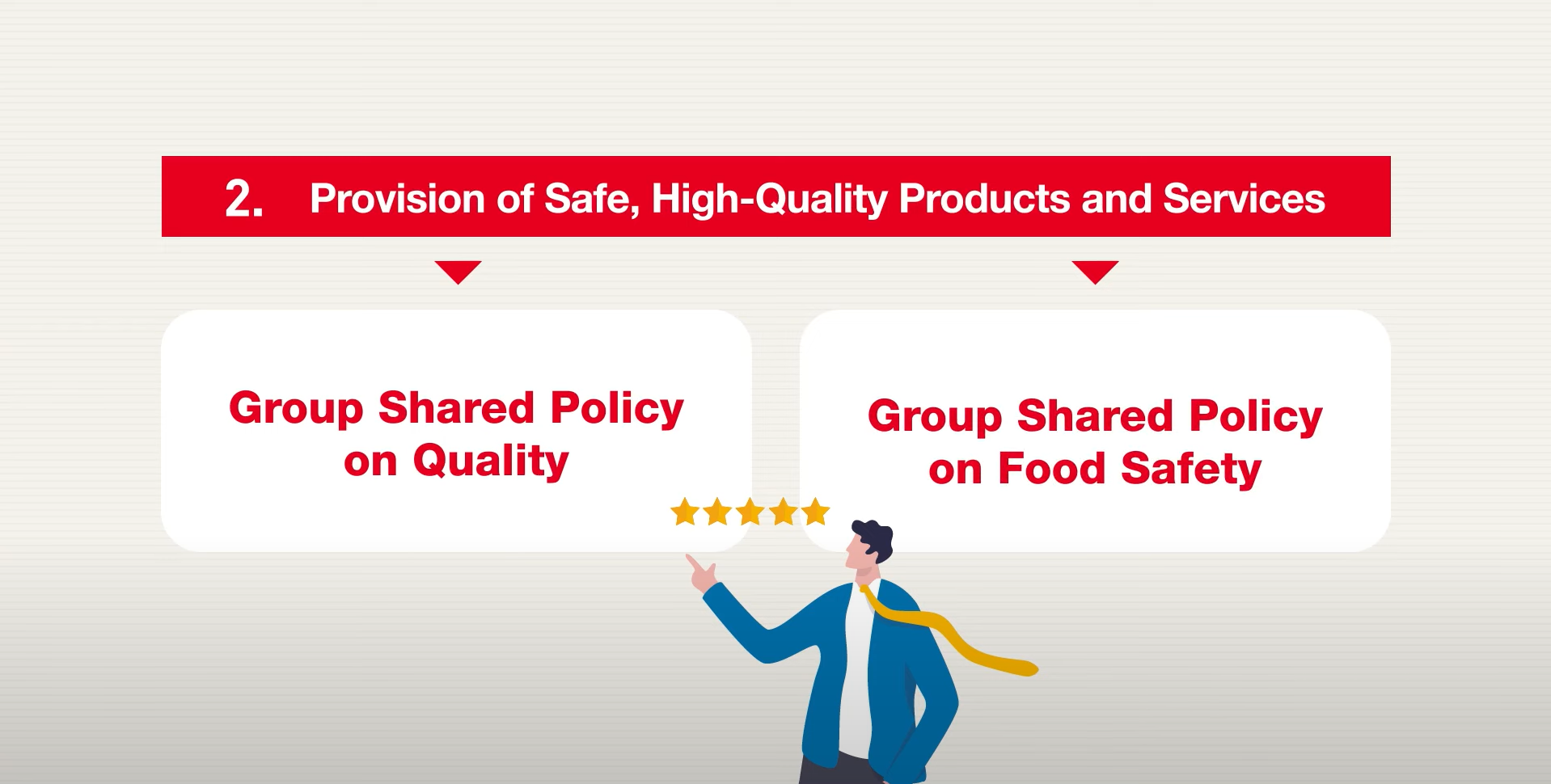
Within the AGP, policies related to quality are included under “2. Provision of safe and high-quality products and services” and consist of the “Group Shared Policy on Quality” and the “Group Shared Policy on Food Safety.”
What the Ajinomoto Group’s Quality Policy Means
Establishing rules is important for quality initiatives. However, it is widely recognized that rules alone do not ensure that they are effectively practiced.
At the Ajinomoto Group, we have established beliefs and behaviors to ensure that quality assurance is embraced as a personal responsibility. This is the Ajinomoto Group’s “Group Policy on Quality.”
The Group Policy on Quality consists of five key pillars:
① We Pay Full Attention to the Requests of Our Customers
We pay full attention to the requests of our customers, and provide products and services that satisfy them.
② We Actively Provide Appropriate Information
We actively provide appropriate information to our customers and continue to improve our trustworthiness.
③ We Make No Compromises With Regard to Safety
We make no compromises with regard to safety, conducting surveys and research as thoroughly as possible, faithfully complying with applicable laws and regulations, and always delivering products and services of uniform quality.
④ We Assure Quality Through the Ajinomoto System of Quality Assurance
We assure quality through the Ajinomoto System of Quality Assurance (ASQUA), based on the concepts outlined in the relevant international ISO standards.
⑤ Each and Every Employee Makes the Greatest Effort
Under the leadership of our management, each one of our companyʼs employees makes the greatest effort to provide safe and high-quality products and services through work at all levels, from research and development to production, distribution, sales and services.
What “Quality Culture” Means to the Ajinomoto Group
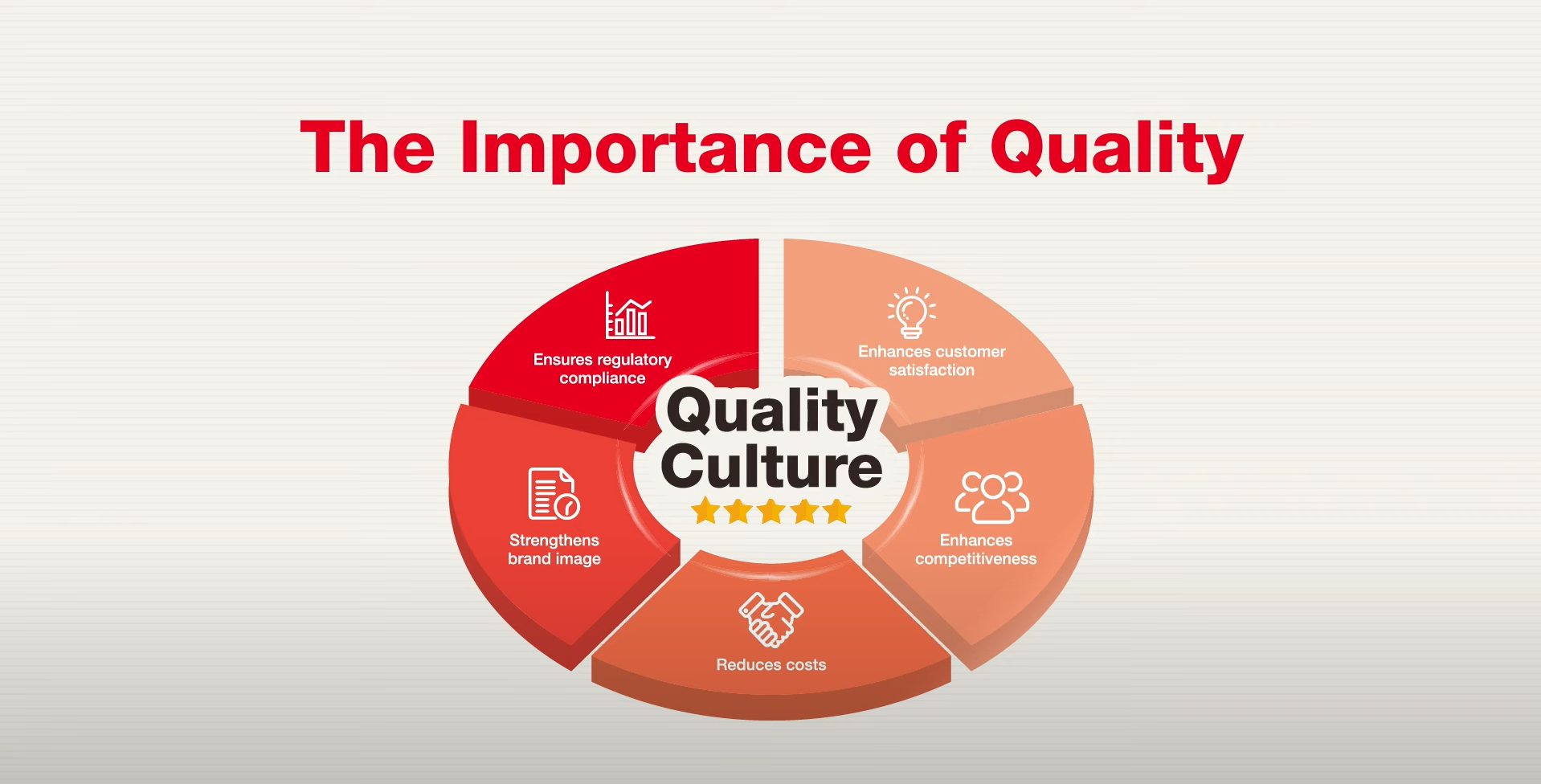

Cultivating a quality culture embedded throughout the organization is essential to consistently deliver safe and high-quality products and services.
Providing safe and high-quality products and services enhances customer satisfaction and strengthens competitiveness in the market. Thorough quality management also leads to cost reductions and improved operational efficiency.
Furthermore, a consistent commitment to quality enhances brand image and builds customer trust. Strict adherence to quality standards ensures compliance with regulations and fulfills social responsibility.
These elements interact with one another, and quality contributes to the foundation of sustainable growth.
This quality culture forms a critical foundation supporting the Ajinomoto Group’s quality initiatives.
Quality culture refers to a set of shared values that influence our mindset and actions regarding quality.
The Ajinomoto Group vision for quality culture aims for all employees to share a common value of helping to provide safe and high-quality products and services. In other words, we achieve the Ajinomoto Group vision for quality culture when each and every Ajinomoto Group employee embodies the Group Shared Policies on Quality in their daily work.
Our Initiatives and Employee Insights
Below is a brief overview of specific initiatives undertaken at each step, from production through delivery to customers.
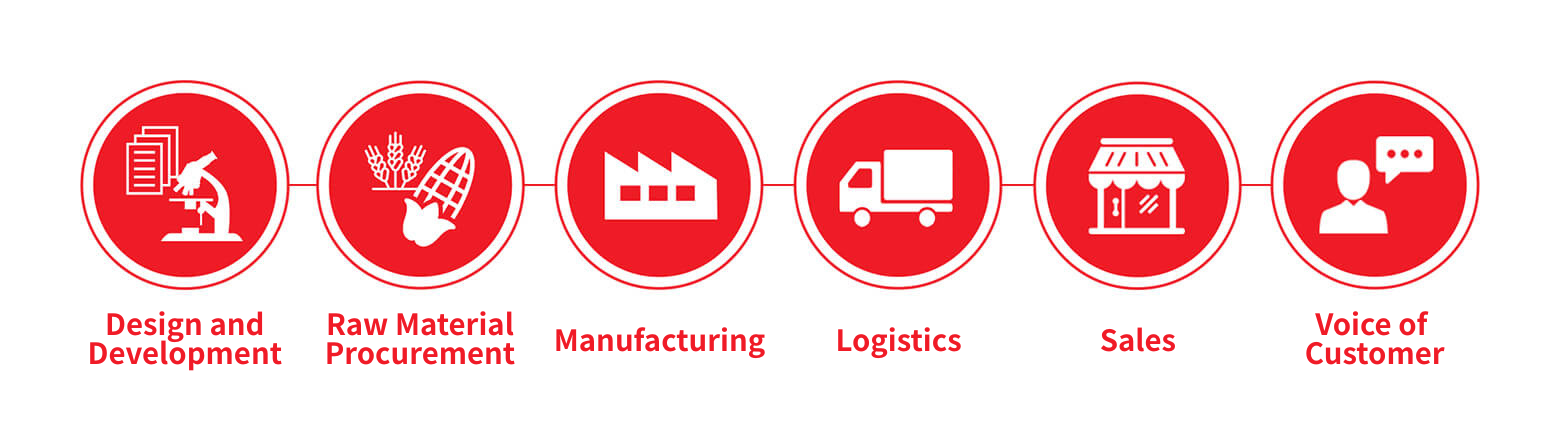
Designing and Development
Designing and Developing Products that Delight Our Customers
In accordance with the “Quality Assessment Standards” defined under ASQUA, quality assessments are rigorously evaluated at each stage of product development. Only products that pass all assessments reach customers.
Raw Material Procurement
Providing Safe, High-quality Products
The Ajinomoto Group comprehensively identifies raw materials used in its business activities. Working closely with relevant internal departments and external experts, we identify priority raw materials that require focused efforts, particularly in the agricultural, forestry, and fisheries sectors.
Manufacturing
Ensuring a Stable Supply of Safe, High‑Quality Products
To provide customers with a stable supply of safe, high‑quality products, the Ajinomoto Group implements rigorous quality control in accordance with standards for HACCP, GMP, food defense, and other requirements established under its ASQUA framework.
HACCP: Hazard Analysis and Critical Control Point; A hygiene management system in which food safety is addressed through the scientific analysis and control of hazards throughout all stages of the process, from the receipt of raw materials to the shipment of finished products.
GMP: Good Manufacturing Practice; a set of standards for managing manufacturing processes to ensure product safety and consistent quality throughout all stages, from the receipt of raw materials to production and shipment. In Japan, GMP is legally mandated for the manufacture of pharmaceutical products.
Logistics
Delivering High-Value Logistics Quality
In Japan, the Ajinomoto Group collaborates with specialized logistics partners for order processing, storage, and delivery, while implementing rigorous quality control measures to manage freshness, temperature, humidity, and other conditions.
Overseas, the Ajinomoto Group also works closely with local logistics providers, taking into account regional logistics environments, and has begun supporting them in implementing logistics quality standards and expertise developed in Japan.
Sales
Sales Activities that Clearly Communicate Product Value
To help customers feel confident using our household products, the Ajinomoto Group provides helpful information not only on product packaging but also through its websites and at retail stores.
Voices of Customers
Improving Quality Through a Customer-Focused Approach
Customer feedback is utilized to develop and improve the value of our products and services.
Our Ongoing Commitment to Quality Assurance
The Ajinomoto Group does not regard quality assurance as a responsibility confined to management or specific departments but as a theme that every employee takes personal ownership of.
Why does each Ajinomoto Group employee place such importance on quality assurance?
This is because employees see quality assurance not only as a fundamental corporate responsibility to customers, but also as a commitment that cultivates their own personal growth and contributes to the Ajinomoto Group’s purpose of “contributing to the well‑being of all human beings, our society, and our planet through “AminoScience.”
Finally, below is a video conveying messages from members involved in quality assurance across the Ajinomoto Group companies.
Video: The Ajinomoto Group’s thoughts on quality
Related Link

Stories you may like

Modal Shift: a flexible logistics solution that eases truck driver shortages while reducing environmental impacts
- Diversity
- Purpose

Optimizing Plastic Mayonnaise Container Recycling and Much More
- Diversity
- Purpose
Putting every part of our skipjack tuna to good use. How does the Ajinomoto Group conceive of sustainable food systems and aspire for “Well-being”?
- Diversity
- Purpose